|
Getting your Trinity Audio player ready...
|
Crack open something seasonal and picture this: four venues running at once across downtown Rochester, festival grounds spread over what organizers called 17 acres, enough tables to seat thousands at a sitting, and—in its biggest year, 1975—11 straight days of it. Most years it ran nine days, even after that 11-day peak.
That’s roughly what Rochester actually built during Oktoberfest’s peak years in the mid-1970s.
The event lived in four separate spots at once by 1975: the Hof Brau Haus inside the old Edwards Store, the Bavarische Trink Schule up at East Main and Elm, a Würzburger Bier Garten set up literally in the middle of Main Street, and the Regenbogen Haus over at St. Paul and Mortimer. A 1976 account of the festival tallied what a full Rochester Oktoberfest took to stock—100 cases of German Rhine wine, 2,500 barrels of local and imported beer, 200 cases of sauerkraut, and 15,000 pounds of sausage.
Fourteen different bands rotated through in 1975 alone, everything from a touring Austrian ensemble to local firemen’s polka outfits, and the festival opened with an actual civic ceremony, the mayor and the Monroe County Legislature president presiding over the keg tapping like it was a ribbon cutting. There was a German Mass with a procession down Main Street. This was not a brewery parking lot with a food truck. This was the city organizing around a beer festival the way it might organize around a parade.
Bill and Betty Oswald started it much smaller, behind their Hof Brau Haus restaurant on Lyell Avenue around 1970, with a tent that drew maybe 4,000 people over three days. By 1972, it had already grown into a nine-day event with a brass band flown in from Germany, and the crowd hit 14,000 by 1973. The city and county got involved in 1974, moving the whole thing downtown into the vacant Edwards Building. The first downtown weekend alone drew 15,000 people, and organizers projected that the full nine-day run could clear something on the order of 500,000—an estimate going in, not a final head count.
By 1976, the festival had outgrown even the Edwards Building and relocated permanently to Manhattan Square, with Sibley’s running its own German-food tie-in downstairs and leaving its Main Street windows lit until midnight for the duration. Midtown Plaza got in on it too, building a whole Bavarian café called Das Kleine Hoch Haus that ran food and music through the entire festival run. Organizers were comfortable enough in the festival’s stature to talk about extending it into October and measuring themselves against Munich and against Kitchener-Waterloo’s Canadian Oktoberfest, the other big North American claimant to the title.

And then there’s the elephant, which turns out to be completely real. A Democrat and Chronicle photo from August 1981 shows festival promoter Walter Schabel arriving at the Main Street tent riding one, beer stein in hand, using the elephant’s trunk to help tap the first keg of the season. The caption notes the festival had started the day before and would run through the end of August that year. It’s the kind of stunt that sounds invented until you’re looking at the photo.
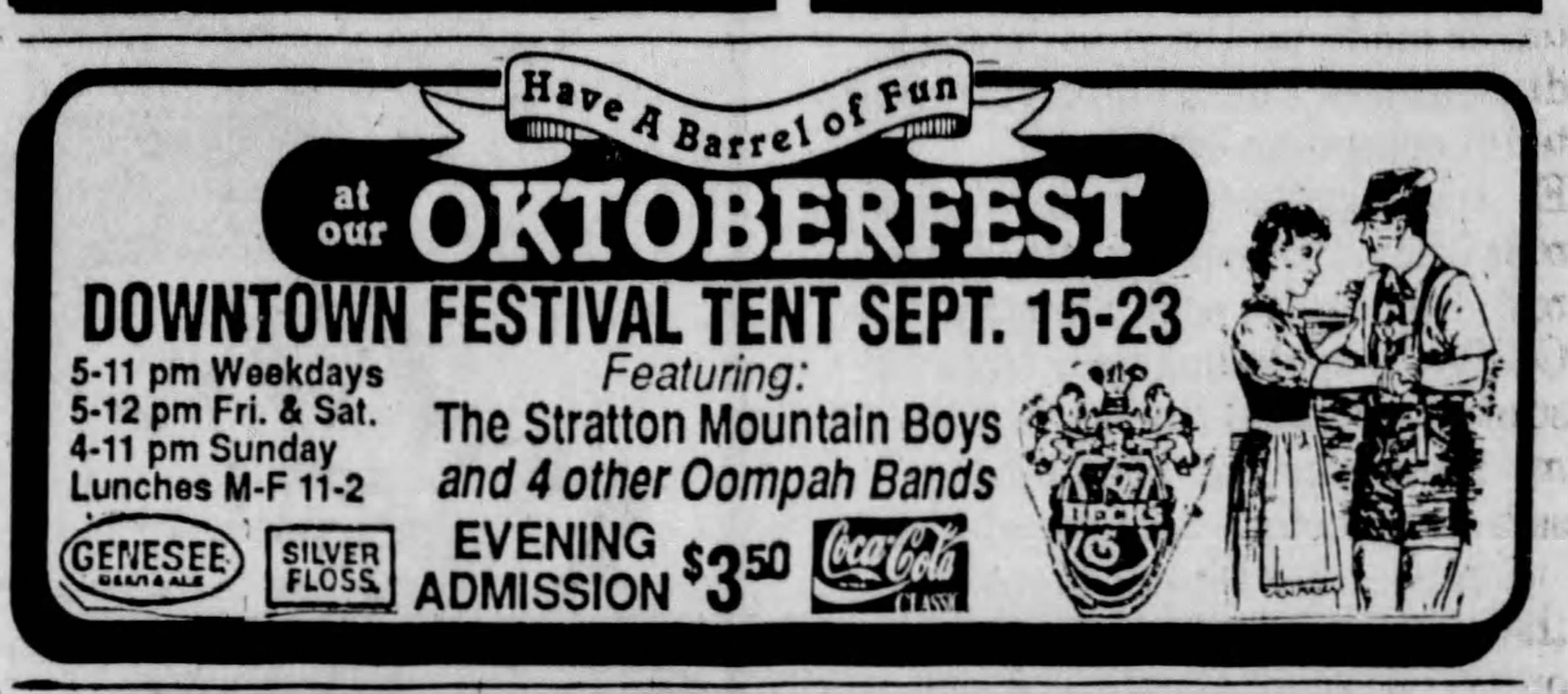
Ticket prices stayed modest through most of this. One surviving ad for the downtown festival tent lists evening admission at $3.50, with Genesee and Beck’s on tap and lunch served free during the day. Fourteen bands, four venues, tons of sausage and sauerkraut, and all of it for $3.50.
Success created its own problem. Once Oktoberfest proved it could pull a crowd, every bar and strip mall in Monroe County started slapping the name on its own version, and the Oswalds, watching their brand get watered down by imitators, eventually pulled their operation back to Lyell Avenue for a stretch. Downtown Oktoberfest kept going without them under other promoters, but it took until 1984 for anyone to seriously try rebuilding it with any ambition.
Bill Oswald Jr., 28 at the time and just off a job working with emotionally disturbed kids in Colorado, took over that year and relaunched near South Clinton and Woodbury with an explicit goal of making the festival genuinely German again rather than another watered-down local version. That meant real sausage sourced from Zimmermann’s and Effinger’s, whole pigs roasted on-site by a vendor who drove up from Pennsylvania specifically for the job, and an imported beer night stacked with European brews next to Genesee’s own Oktoberfest dark.
By 1985, in the festival’s 15th year, somebody finally brought in an actual Bavarian to take a look. Eberhard Lindner, a Munich native working as food-and-beverage director at the Thruway Marriott, gave the local version an honest but not unkind review. “Munich is my hometown,” he said, and Rochester’s festival, whatever its ambitions, simply wasn’t built on the same scale as one that dated to the early 1800s and roasted whole oxen over open pits. His own wish list for a Rochester Oktoberfest menu ran in that day’s paper right next to the recipes: roast pork or sauerbraten, potato dumplings, braised red cabbage, and steckerlfisch grilled whole on a stick.
The collapse, when it came, wasn’t really about Oktoberfest at all—it was about the tent. Downtown’s ethnic festivals, Oktoberfest included, had shared a single 36,000-square-foot festival tent on Woodbury Boulevard since 1974, and in 1986 alone that tent drew 120,000 people across 24 different events. Then the city needed the site for a parking garage. Mayor Thomas Ryan Jr. shut down the tent for the 1987 season to make room for construction, and downtown lost its festival infrastructure in one stroke—including La Fiera Italiana and the other festivals that had relied on it.
A 1987 Democrat and Chronicle column caught the fallout from Oktoberfest’s side, noting the festival’s usual downtown site had been lost to parking needs and the event pushed out to a banquet hall in Henrietta, a move Bill Oswald reportedly hated since the whole point of doing this downtown had been pulling people into the city. The tent itself came back in 1989, rebuilt and rebooked for other festivals, but the big downtown Oktoberfest never really returned to it in the old form.
The Hof Brau Haus outlasted its own festival by three years, and not by much. Bill Oswald closed the restaurant in June 1990, 20 years to the month after he’d opened it, and that November an auctioneer worked through the dining room selling off brewery signs, beer steins, and German artwork to whoever showed up. The place that started the whole thing on a Lyell Avenue parking lot went out the same way a lot of Rochester institutions did around then—quietly, at auction, with the fixtures going home with strangers.

By then the region’s Oktoberfest energy had already relocated. Irondequoit held its first Oktoberfest at Camp Eastman in 1988, the same year downtown lost its tent, drawing a modest 2,500 to 3,000 people over three days as a fundraiser to renovate the park. It grew quickly—by its fourth year in 1991 it had stretched to six days, brought in corporate sponsors, and was pulling crowds several times its opening size, with organizers explicitly building it as something that could keep growing for years rather than burning out the way downtown’s version had. By 1995 it was big enough that a national E. coli scare had people asking questions about festival food safety, and the D&C sent a reporter out to a demonstration by a Health Department “krautcutter” to reassure everyone the sauerkraut was fine.
That version ran for roughly three decades before it wound down. By 2022, a Democrat and Chronicle retrospective was describing Irondequoit’s Oktoberfest in the past tense, tracing it back to the 1980s and noting how a small tent with beer, brats, and a “guy sausage in the parking lot” had eventually grown to fill two or three tents at Camp Eastman before the event stopped running altogether. When Webster’s Immanuel Lutheran Church started up its own new Oktoberfest that year, the town of Irondequoit donated leftover equipment, including 500 one-liter beer steins that had originally been ordered for Camp Eastman events that never happened. Fairport’s own Oktoberfest, running a week after Webster’s, carries some of that same Irondequoit tradition too—smaller and more casual than downtown ever was, but still built on German beer, Bavarian bands, and a lot of people showing up in September because that’s just what you do around here.
The big downtown festival was never the whole story of Rochester’s German heritage, either. A 1994 feature on the area’s German-American community pointed to neighborhoods like Dutchtown south of Lyell and Swillburg off South Clinton, and to a dozen active heritage groups under the Federation of German-American Societies still running their own smaller Oktoberfests around the region every fall—including one at Rohrbach Brewing, which by then was already pouring German-style lagers out of the old German House building on Gregory Street.
What’s left now is scattered across the region in that same spirit. Just about every brewery throws something called Oktoberfest in September. Most are much smaller affairs—a seasonal lager on tap, a few picnic tables, maybe a band. Swiftwater, for instance, has Andy Cook driving across the state to bring back lagers from some of the best producers in New York. Genesee Brew House leans on the brand’s own history with the holiday, and the old newspaper ads back that up—Genesee beer was pouring at these festivals as far back as the 1970s, so there’s a real thread connecting what they’re doing now to what was happening downtown 50 years ago.
Will Cleveland is a Rochester Beacon contributing writer. A former Democrat and Chronicle reporter, he writes about beer in the Finger Lakes region and Western New York on Substack.
The Beacon welcomes comments and letters from readers who adhere to our comment policy including use of their full, real name. See “Leave a Reply” below to discuss on this post. Comments of a general nature may be submitted to the Letters page by emailing [email protected].