|
Getting your Trinity Audio player ready...
|
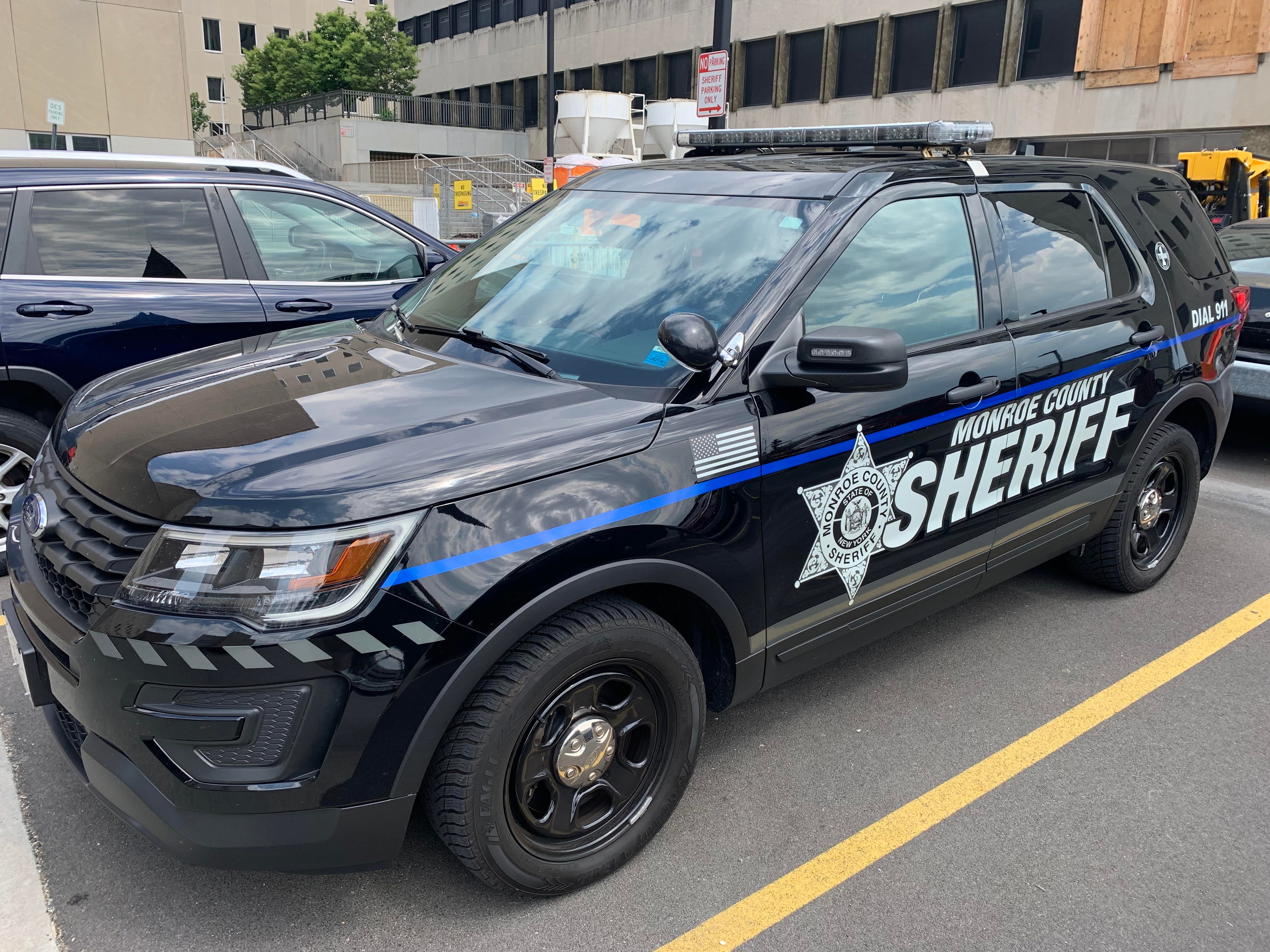
The Monroe County Sheriff’s Office shares data from its license plate readers with 392 state and local law enforcement agencies. The list of those agencies has not been made public.
The agencies are in 20 states, according to a presentation the office gave Democratic county legislators Tuesday. Office policy allows sharing with agencies in New York and 22 other states, running from Maine to Florida and west to Michigan and Mississippi.
The agencies were “specifically selected by region due to known criminal trafficking enterprises,” Chief Deputy Michael Fowler said Tuesday in written answers provided to the Beacon. He did not name them or say who approved each arrangement.
Fowler gave Democratic legislators a list of the 392 agencies at Tuesday’s meeting, County Legislator Rachel Barnhart said. It is on paper and has not been released publicly, she said.
Barnhart, a Democrat, called on the sheriff’s office Tuesday to stop sharing the data with agencies that have agreements to help U.S. Immigration and Customs Enforcement, known as 287(g) agreements.
“The sheriff closed the front door to ICE, but left the back door wide open,” Barnhart said in a statement. “Once data leaves Monroe County, we have no control.”
What the office can and can’t see
Barnhart said Fowler told the caucus there is no way to know how the outside agencies use Monroe County’s data, including whether they give federal agencies access to their own systems.
In his written answers to the Beacon, Fowler said the office can see when an outside agency searches.
“Every time an agency we share with searches any license plate our system tracks and logs it,” he wrote. Those searches “are all subject to audit.”
He did not address what an agency does with the results. He also did not say how many outside searches there have been or whether the office would release the log. No log of outside searches was among the 437 pages the office released Nov. 4 in response to a Freedom of Information Law request. Barnhart said the caucus did not ask for it Tuesday.
Barnhart said outside agencies have searched the data thousands of times. She said many of those agencies have 287(g) agreements. The sheriff’s office has not released the list of agencies.
According to Barnhart, Fowler acknowledged the risk in sharing with such agencies. He told legislators the Motorola system does not let Monroe County require that searches of its data be screened first, that he has asked Motorola for that feature, and that turning the sharing off would pose a greater safety risk than waiting for it, she said.
Fowler does not necessarily disagree with cutting off agencies that have 287(g) agreements, Barnhart said. He wants the filter first.
“It is astonishing to me that our choices appear to be: allow hundreds of agencies unlimited access to our license plate reader data or wait for Motorola to put in some filters,” Barnhart said. “It’s all or nothing? Why are we at the mercy of a multibillion-dollar technology company?”
The office does choose its partners. Fowler’s answers describe the 392 agencies as selected by region, and the policy in effect until September required a captain to approve or deny each sharing request.
The sheriff’s office had not responded by publication time to a request to confirm Barnhart’s account of the meeting. This story will be updated if it does.
Nothing in the records reviewed for this story shows Monroe County data reaching federal immigration authorities. The sheriff’s office says it has no data-sharing agreements with federal agencies.
A promise, and a policy that came later
The Legislature voted 25-4 in May 2025 to allow readers on state rights-of-way. A month earlier, Fowler told a committee the cameras would not be used to help federal immigration enforcement, WXXI reported at the time.
The policy in effect then said nothing about immigration. That is according to a copy obtained through a Freedom of Information Law request for a joint Genesee Signal and Rochester Beacon project. The policy, issued in September 2024, also set no limit on which states could receive data. It required approval from a captain or the captain’s designee before data was shared automatically with another agency. It remained in effect until Sept. 21.
The replacement took effect Sept. 21, six weeks after Democratic legislators sent the sheriff a list of questions. It bars sharing data “for the purpose of immigration enforcement without a corresponding additional violation” of law. It prohibits searches based “solely” on civil immigration enforcement. And it says no “automatic data sharing agreement” will be made with a federal agency.
Fowler wrote that the earlier policy “was written prior to ALPR deployment” and that nothing about the office’s practice has changed.
“This is not really a story,” he wrote. “Our operations involving Immigration enforcement have not changed. What did change is a few people spreading misinformation so we decided to spell it out to eliminate any confusion.”
“The new policy appears quite thoughtful in its privacy protections—until you get to the part about sharing our data with an untold number of agencies in 22 other states,” Barnhart said in an email Monday, before the office gave the number.
In a Sept. 30 memo to county legislators, Fowler wrote that sharing is limited to agencies that use the same Motorola platform and have agreed to share their own data in return.
Legislators had asked in August for a list of every outside agency with access. The memo names states only.
What the search logs show
The sheriff’s office released a log of searches its own users ran in the Motorola system from January 2024 to mid-July 2026. It does not show searches other agencies ran on Monroe County’s data.
No search in the readable pages of that log is labeled as immigration-related. About a third give only a generic reason, such as “inv” or “investigation.”
At least 11 cite a federal agency or task force, including the Drug Enforcement Administration, the U.S. Marshals Service and the FBI. One, in May, was logged as a fraud investigation assist for the Florida Department of Law Enforcement.
Eight of those 11 returned records.
“All of those searches are on behalf of task forces for criminal investigations,” Fowler wrote.
The office has described its federal contacts three ways. Fowler’s Sept. 30 memo said it had received no federal requests for plate reader data. Barnhart said the office told legislators Tuesday that one search that produced a hit in Monroe County data was run on behalf of a federal agency, the FBI. The log shows one search citing the FBI, on June 25.
Fowler told legislators in the memo that the system could not break searches down by month. The log is timestamped. It shows 102 searches in October 2025 and 628 in April 2026.
His memo says audits began in February and covered 79 of 164 users, finding 24 “procedural discrepancies” and no misuse. The earlier policy required monthly audits. The new one requires quarterly audits of at least six users.
Asked why, Fowler wrote that the office “learned that quarterly is more appropriate and accomplishes the same effectiveness.” He did not say whether the monthly audits were done.
‘No longer under local control’
Daniel Schwarz, senior privacy and technology strategist at the New York Civil Liberties Union, said shared databases change what a local camera network is. He spoke in an earlier interview about license plate readers generally, not about Monroe County.
“You end up with a mass surveillance database that can be used for all sorts of purposes and suddenly they’re no longer under local control,” Schwarz said.
Asked this week about Monroe County’s policy, he was blunter. A 22-state limit is “hardly a reasonable limitation,” Schwarz said in an email Tuesday, before the sheriff’s office had answered the Beacon’s questions. He called it “reckless overbroad sharing without oversight.”
Two New York cases involving a different vendor, Flock Safety, show how far shared data can travel.
In Troy, agencies across the country searched the city’s data about 12.2 million times from April 2024 to March 2026, according to a report compiled from Troy police audit logs. Ninety-four percent came from out-of-state agencies. Troy police turned off Flock’s national lookup feature on March 18. Outside searches fell to about 38,600 in April, nearly all from New York agencies.
In Syracuse, police data appeared in nearly 4.4 million searches from June 2024, Central Current reported in July 2025. Of those, 2,097 were labeled immigration-related. Most were broad searches across many agencies’ databases. Syracuse police said they opted into the national network inadvertently, despite city guidance against sharing.
“Local departments don’t know who accesses their data,” Schwarz said. “They don’t confirm or grant permission on a case-by-case basis.”
Monroe County’s arrangement differs in two respects, by the sheriff’s office’s account. It shares only with agencies in the named states, not through a national lookup. And it says every outside search is logged.
What the system is
The sheriff’s office says the readers work. Cases it has posted online and summarized for legislators describe the readers helping to find stolen cars, missing people and suspects in robberies and a homicide.
The county paid $2.85 million in state grant money for the Motorola system, including 144 fixed cameras, a purchase order shows. Patrol cars carry a second set of readers under a separate contract with Axon, which licenses them for 65 vehicles. Fowler’s memo says the Axon data is shared only with the state-run Monroe Crime Analysis Center.
What comes next
The question is also before state lawmakers. New York has no law regulating license plate readers, and three Assembly committees held a hearing on them Monday in Albany.
Pending bills, A.10808A and S.9890A, would restrict how the readers can be used, require unused data to be deleted within 48 hours and require a judge’s authorization for any out-of-state access, according to the NYCLU, which supports them. Monroe County’s policy keeps plate data for 12 months.
Both bills remain in committee and must be reintroduced if they don’t pass by Dec. 31. As amended in late October, they would not stop counties from passing stricter rules of their own.
Unregulated plate readers “are a statewide problem, and New Yorkers need a statewide solution,” Schwarz said in written testimony to the committees.
Without a warrant requirement for out-of-state access, he wrote, plate reader systems “become instruments of federal overreach and out-of-state prosecution, circumventing local sanctuary and shield laws.”

Albany County Sheriff Craig Apple, president of the New York State Sheriffs’ Association, testified that tips often come in days, weeks or months after a crime.
“Look—24 hours, 48 hours I think is just unrealistic and you might as well just get rid of the cameras altogether,” Apple said, according to Gothamist.
Apple suggested the state Division of Criminal Justice Services could review agencies’ audits or conduct its own, the Times Union reported. Monroe County’s readers were paid for with a grant from that agency.
When legislators asked in August for the Motorola contract’s data-sharing terms, they received the company’s general privacy policy.
The sheriff’s office told legislators Tuesday that a page on its website now carries the policy, answers to common questions and Motorola’s privacy policy. A dashboard of plate reader statistics is listed there as “coming soon.”
The request for these records was filed in August. The county released 437 pages on Nov. 4 and closed the request. An appeal is pending.
Will Cleveland is a Rochester Beacon contributing writer and a former Democrat and Chronicle reporter. He writes about beer in the Finger Lakes region and Western New York at Cleveland Prost and publishes investigative pieces at The Genesee Signal.
The Beacon welcomes comments and letters from readers who adhere to our comment policy including use of their full, real name. See “Leave a Reply” below to discuss on this post. Comments of a general nature may be submitted to the Letters page by emailing [email protected].